Bobby Darin, Jack Jones, Al Martino, Frank Sinatra (#1 in 1966), Bert Kaempfert (#8 in 1967), Bette Midler (#45 in 1976)
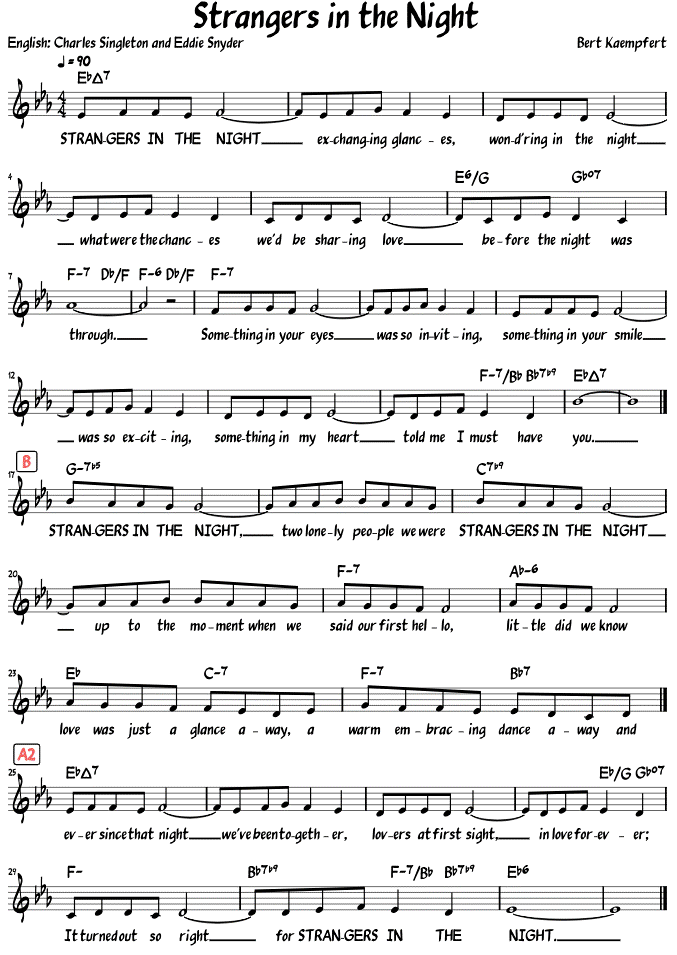
Strangers in the night exchanging glances
Wond'ring in the night what were the chances
We'd be sharing love before the night was through
Something in your eyes was so inviting
Something in you smile was so exciting
Something in my heart told me I must have you
Strangers in the night
Two lonely people, we were strangers in the night
Up to the moment when we said our first hello little did we know
Love was just a glance away, a warm embracing dance away
and
Ever since that night we've been together
Lovers at first sight, in love forever
It turned out so right for strangers in the night
"Strangers in the Night" is a song composed by Bert Kaempfert with English lyrics by Charles Singleton and Eddie Snyder. Kaempfert originally used it under the title "Beddy Bye" as part of the instrumental score for the movie A Man Could Get Killed. Sinatra would record the theme tune titled "Beddy Bye" if lyrics were written for the song, and that the title needed to be changed. The writing of the lyrics, however, took a few months. Two sets of lyrics were produced but both were rejected.
The song was said originally to have been sung by Melina Mercouri, who thought that a man's vocals would better suit the melody and therefore declined to sing it.
Sinatra's recording won him the Grammy Award for Best Male Pop Vocal Performance and the Grammy Award for Record of the Year, as well as a Grammy Award for Best Arrangement Accompanying a Vocalist or Instrumentalist for Ernie Freeman at the Grammy Awards of 1967.
A number of artists recorded the song before Frank Sinatra, including Bobby Darin who recorded the song on March 23, 1966, Jack Jones on April 8, as well as Al Martino. Bowen (Sinatra's producer), however, was unaware that Fine had given the song for others to record, and was surprised when he came across Jones who informed him that he would be recording the song and that it would be released within days. Bowen quickly contacted Ernie Freeman to come up with an arrangement for Frank Sinatra to record "Strangers in the Night" to beat Jones to the song's release. Hal Blaine and Glen Campbell (as members of "The Wrecking Crew") were on the recording. Campbell, who was brought in the last minute to play rhythm guitar in his first session with Sinatra. As Campbell could not read sheet music, he spent the first take listening to the melody instead of playing, which prompted Sinatra to yell out at him if he was sleeping.
The song features a half-tone key change around 2/3 of the way into song, which created a problem when Sinatra could not adjust to the key change. According to Bowen, he resolved the issue by asking Sinatra to sing until the just before the key change, stopped, then gave him a bell tone so he could sing the next section in the new key.
Due to the rush-release of Sinatra's record, Jones' version failed to chart. Jones' recording became instead the B-side to "The Impossible Dream", which followed Sinatra's "Strangers in the Night" as No. 1 on the Easy Listening (AC) chart. Darin's recording was never released, while Martino was out of the country and could not promote the song when Sinatra's version was released.
Sinatra, despised the song, calling it at one time "a piece of shit" and "the worst fucking song that I have ever heard."[25] Joe Smith, then head of Reprise Records, said "[Sinatra] thought it was about two fags in a bar!" Dean Martin had teased Sinatra when the song was being released, saying that he turned down the song because "it's about two faggots". In concert, Sinatra had on many occasions sung the lines "Love was just a glance away, a warm embracing dance away" as "a lonesome pair of pants away".
The song received the Grammy Award for Best Male Pop Vocal Performance and the Grammy Award for Record of the Year, as well as a Grammy Award for Best Arrangement Accompanying a Vocalist or Instrumentalist for Ernie Freeman at the Grammy Awards of 1967. It also received the award for best original song at the 24th Golden Globe Awards.
In 2008, "Strangers in the Night" was inducted into the Grammy Hall of Fame.
The name of cartoon dog character Scooby-Doo is derived from the scat in the song. CBS television executive Fred Silverman listened to the song in 1968 while on a red-eye flight to a development meeting for Scooby-Doo, Where Are You! and was inspired by the scat. The creators knew if they named the cartoon dog“Dooby Dooby Doo” they’d get sued, so they named him Scooby Doo.
Sinatra's improvised scat at the end of the song became a meme in philosophy, thus:
"To be is to do" - Socrates.
"To do is to be" - Jean-Paul Sartre.
"Do be do be do" - Frank Sinatra.
In the summer of 1966, the American airwaves were dominated by the sonic experimentation of the British Invasion and the rising tide of psychedelic rock. Yet, on July 2, an old-school titan managed to do the impossible. Frank Sinatra climbed to the Number 1 spot on the Billboard Hot 100 with his romantic ballad "Strangers in the Night." It was a monumental achievement that knocked The Beatles' "Paperback Writer" off the throne, secured Sinatra a Grammy for Record of the Year, and ended an agonizing 11-year drought since his last solo chart-topper, 1955's "Learnin' the Blues."
There was just one problem: Frank Sinatra absolutely hated it.
To Sinatra, a master of lyrical phrasing and sophisticated jazz standards, the track was an over-produced, simplistic piece of commercial fluff. The song had been cobbled together quickly, adaptation of an instrumental piece by German bandleader Bert Kaempfert with English lyrics penned by Charles Singleton and Eddie Snyder. Sinatra reportedly didn't want to record it at all, but was pressured into the studio by producer Jimmy Bowen, who knew they had a commercial goldmine on their hands.
Bowen was right about the public, but dead wrong about winning over the artist. Once the track became a global phenomenon, Sinatra found himself trapped by his own success. Audiences demanded the song at every single concert. Ever the professional, "Chairman of the Board" gave the people what they wanted, but he refused to hide his utter disdain.